
Strangles
Strangles: the most prevalent infectious respiratory disease in horses worldwide and endemic to New Zealand.
Strangles Update | 18th September 2026
Current status:
The total number of properties has dropped to seven, all of which are Waikato based.
The outbreak is primarily affecting training and pre-training properties, with some stud farm properties also affected.
At this stage, the cases remain confined to the thoroughbred population and are largely restricted to one regional area. While everyone involved with horses should remain vigilant and continue to maintain good biosecurity and disease control practices, there is currently no evidence of transmission into other horse populations.
The potential consequences of the outbreak are far-reaching. Industry bodies, including NZTR, Harness Racing, Trainers Association, Breeders, Exporters, sales companies, etc are formulating industry-specific guidelines. This is an evolving situation that will require the industry to remain agile and adapt as new developments emerge.
It should be noted that there are multiple references to the use of SAA testing; whilst this test is available in the Waikato and Auckland, there will be regions where this test may NOT be available.

Strangles is a highly contagious disease of equids, including horses, donkeys and ponies. It is caused by the bacteria Streptococcus equi, often abbreviated Strep. Equi. It is called "strangles" because of the strangled breathing sounds the very ill horse may make as a result of profuse nasal discharge and the swellings that form in the head and neck region.
Most animals fully recover from strangles in two to four weeks. Although enduring immunity against re-infection is variable, in some equids it can last for years. However, not all horses develop a protective immunity upon recovery. Some horses, although they appear healthy, shed bacteria in nasal secretions for an extended period and can infect nearby horses.
Because Strangles is already in New Zealand, it is called an ENDEMIC disease. Currently there is no formal control programme for the disease, but almost all of the formal equestrian sporting bodies have rules preventing strangles-infected animals from attending events.
Together the New Zealand Equine Research Foundation and the Rodmor Charitable Trust have kindly sponsored an informative video on strangles presented by equine veterinarian Dr Paul Fraser. Further information for horse owners on Strangles can be found below the video.
STRANGLES: What Horse Owners Need to Know
WHAT IT IS
Strangles is a highly contagious bacterial infection caused by Streptococcus equi subspecies equi (S. equi ssp equi). It affects the upper airways and lymph nodes around the head and neck. Note there's a closely related subspecies, S. equi ssp zooepidemicus, which is a different organism and does not cause strangles — so make sure any lab result specifies ssp equi. It spreads easily, but most horses recover fully within 4–6 weeks with good care.
SIGNS TO WATCH FOR
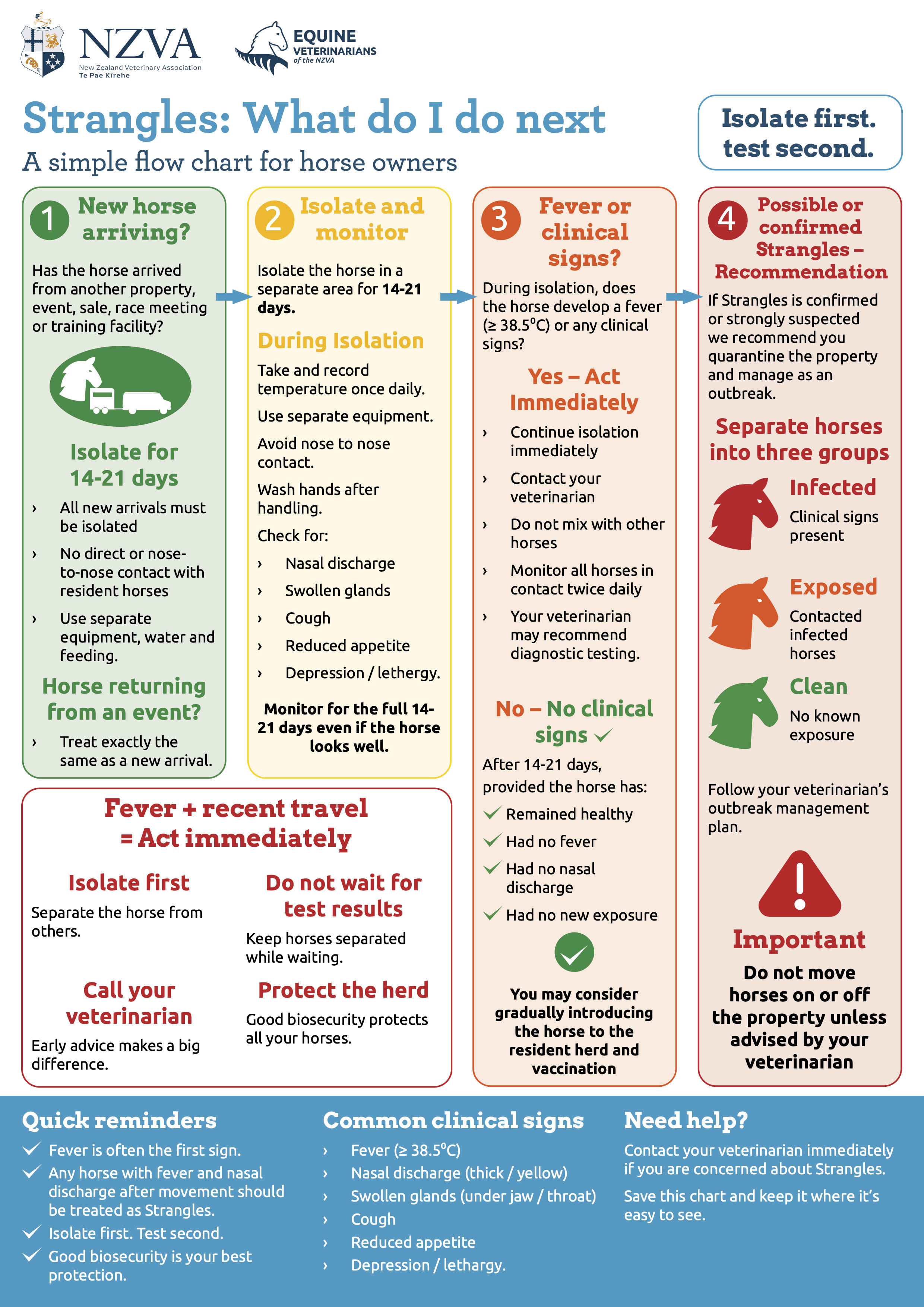
A high temperature is usually the first sign — often before anything else — so take your horse's temperature regularly after travel, events, or contact with new horses. Other signs: lethargy, going off feed, thick yellow nasal discharge, a cough, and swollen lymph nodes under the jaw that may abscess and burst.
Simple rule: fever and a snotty nose after travel or mixing with unfamiliar horses? Treat it as strangles until your vet says otherwise.
IF YOU SUSPECT IT
Isolate first, then call your vet. Keep the affected horse well away from others before doing anything else. Don't assume a horse is clear just because it looks better — they can keep shedding bacteria for weeks. About 1 in 10 recovered horses become silent carriers that look healthy but still infect others, which is why following your vet's testing advice to the end matters.
A WORD ON ANTIBIOTICS
It's important not to reach for antibiotics unless your vet specifically advises them. In most cases they do more harm than good — they can delay abscesses maturing, prolong the illness, and reduce the natural immunity your horse builds. Good nursing care is the mainstay of treatment. Leave the decision to your vet, who will only use antibiotics in specific situations.
QUARANTINE AND PREVENTING SPREAD
New or returning horses: isolate and quarantine for 14–21 days, check temperatures twice daily before mixing, as horses are febrile a couple of days before they are infectious.
Don't share gear: buckets, feed bins, grooming kit, tack and halters all carry it.
Clean transport between trips; wash hands between horses.
Watch the water: bacteria survive 4–6 weeks in troughs and over a month in dried discharge. Sunlight, drying and thorough cleaning kill it faster.
VACCINATION
A key defence, especially for travelling horses. Standard NZ course is three doses two weeks apart, then a yearly booster (six-monthly for high-risk horses), often combined with tetanus (e.g. Equivac 2-in-1). Never vaccinate a horse that's currently sick or recently exposed — it can cause serious complications. Take your vet's advice on timing.
MANAGING ACTIVE STRANGLES CASES
Split horses into three groups and keep them apart: infected, exposed, and clean. Use separate gear (ideally separate people) for each, monitor temperatures twice daily, and stop all movement on and off the property until your vet gives the all-clear.
A NOTE ON STIGMA
Strangles carries an unfair reputation that can make people reluctant to report it. Please don't let that stop you — early, open communication protects every horse. Affected owners deserve support, not judgement.